Posts

Rumors of JITs' demise are greatly exaggerated.

Earlier this week my attention was brought to an article claiming that the dusk was setting for JIT compilation . Naturally, I disagree. I usually try to steer clear of internet arguments, but this time I think I may have something to contribute. Nota bene, this is not a perl- or perl6 related argument, so if that is strictly your interest this is probably not an interesting post for you. The main premise of the argument is that people are shifting away from JIT compilation because the technique has failed to live up to its promises. Those promises include, in various forms, high level languages running 'as fast as C', or having more optimization possibilities than ahead-of-time (AOT) compilers do. Now my perspective may be a bit unusual in that I don't actually expect momentous gains from JIT compilation per se . As I've described in the talk I gave at this years' YAPC::EU, by itself JIT compilation removes only the decoding and dispatch steps of interpretation, ...
Most Significant Bits

This week I think I fixed irregular behavior in the x64 instruction encoding register selction of DynASM. I think it'll be a fun story to share, so I thought it'd be time to blog. The astonishingly irregular thing about x64 instruction encoding is that it is mostly very regular. Ignoring for the moment instruction prefixes and constants, an x86 instruction consists of two bytes, one for the instruction proper, and one for it's two operands. Take for example the addition of two registers: +-----------------+ | add | eax, ecx | +-----------------+ | 0x01 | 0xc8 | +-----------------+ We take the instruction byte as given. It is the second byte that concerns me because it determines which operands to use and how. Like a good CISC architecture, the x86 supports a number of addressing modes , meaning that a register can be used as a value but also as a (part of a) pointer . One of the reasons C does pointer arithmetic so freely is that this reflects the nature of the...

Wrapping Up

Hi everybody, it's been a while since I've blogged, and I think you deserve an update. Last week, of course, was YAPC::EU, which was awesome. Granada is a very nice place, and the weather was excellent. Tapas lunch was very nice, as was the gala diner (also with tapas). There were many interesting people and presentations (many more than I could actually see). It was also very interesting to present ( slides ) about the JIT, which I think went well. One of the comments I heard was that it was a quite high-level talk, so if anyone should ask, I can and will give a talk describing the grueling details in the future. Oh, and I just found that Larry Wall's keynote has just been uploaded to youtube . Go ahead and watch, this page isn't going anywhere. So what news from JIT compiler land? Well, since last I've blogged I had to design and implement the register allocator and tie everything together into the final running compiler. That has been achieved, but there are st...

Tiler Update

Afbeelding
In my last blog I talked a bit about a problem I had with generating all possible sets of rules from the tile 'grammar'. I've since solved that problem, and thought it'd be nice to share my results. (NB: I use the word 'grammar' loosely today and on other days. In compiler jargon a grammar is usually a thing that matches a linear stream of lexical tokens to a tree structure. In this case, it's really the other way around, because it's used to match a tree and output a linear sequence. However, these things are quite similar, so I hope you'll forgive me for using the term). It may help if I state the problem as clearly as I can. The input is a list of rules mapping a head and up to two child nodes to a tile and a nonterminal symbol . A tile, to reiterate, is ultimately a piece of code that emits machine code. The nonterminal symbol (from now on: symbol ) is what takes the place of a node after a tile has been selected for it. This abstraction is...

Inching Closer

Hi everybody, I realise I haven't blogged in a while now, and it'd be a good time to write you an update. I've hit a few problems, but am still making progress. I've written the tiler algorithm for the JIT compiler. This caused a difficulty because the input graph is not a tree but a DAG, meaning that a node may have more than one 'parent' or 'consumer' nodes. Since consumers decide the tiling of their child nodes, this may mean that the tiles conflict. I resolve such tile conflicts simply by adding a new node to replace the old one. I've also been busy adding the tile implementations. These are pieces of C code that emit assembly code corresponding to the part of the input tree they represent. This caused some challenges in that tiles sometimes refer to nodes deep in the tree. I solve this by adding traced paths to the nonterminals to the JIT tile table, allowing the JIT compiler to find the nodes refered to and make them easily available. For e...

Tiles and Compiler Compilers

Afbeelding
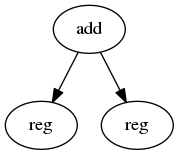
This week I made progress on the central 'tiling' algorithm used for code generation. I think it makes an interesting story and theory, so I will try to explain it in this post. Unfortunately, I don't think I can explain it very well without resorting to computer-science jargon, but I hope you can forgive me. What is tiling? Tiling refers to the process of breaking an input tree into many pieces. The tree refers to the data structures representing the code that the JIT should compile. As I wrote a few weeks back, these trees are ultimately generated from templates, mapped to the MoarVM opcodes. Let's suppose we have a tree for the expression: result = LOCAL[8] + 12 and that it'd look like the code below: (add (load (addr (local) 8) int_sz) (const 8 int_sz)) I realize most people probably are not familiar with the syntax used here. These are called s-expressions, and there is fortunately little to know: '(' opens a...

Of Values

In the interest of the common interest in my little project, I think it's time for me to blog again. Today marks the end of the fifth week of my project period, since my project was planned to take 10 weeks, that means I'm now halfway. So what have I achieved, and what have I learned? Well, I promised to deliver the following things: An implementation of the code generation algorithm described below, including instruction selection tables for the x64 architecture A runtime representation of machine operations ('expressions') that will form the input to the code generator and is suitable for targeting to different architectures A patched version of DynASM capable of addressing the extended registers of x64 Conversion of large parts of the current JIT to the new algorithm An extension API for REPR ops to insert (inline) expressions into the JIT in place of some operations A set of automated tests known to trigger JIT compilation to either the NQP or Rakudo Perl 6 t...